Krisna Gupta

My name is Krisna, some call me Imed. I am an advisor at the Indonesian National Economic Council. My research is about trade and investment policy and how it affects Indonesian firms. I use some structured equation such as GTAP model, but also do some empirics like gravity models.

I lecture at Universitas Indonesia. Additionally, I assume a senior fellow position at Center for Indonesian Policy Studies.

I contributed to several projects with Bank Indonesia, Bappenas, ADB, Prospera, and ERIA, among others. Occasional oped writer, typically at Kompas, Jakarta Post and East Asia Forum. Please see CV or contact me for more information.
Menggunakan Darts untuk melihat bedanya prediksi harga beras domestik dan internasional sejak Neraca Komoditas

I’m one of the regular readers of tweets by Haryo Aswicahyono, who often talks about economics. Just the other day, he tweeted mainly about how rice prices remain high, even though there’s an abundant supply. Here’s the tweet:

Aug 2, 2025

Melihat Indonesia lewat kacamata Ray Dalio: Bagaimana Negara Bankrut

About Ray Dalio’s Book I just finished reading Ray Dalio’s book titled How Countries Go Broke, which illustrates how nations fall into debt crises. It starts with the premise that the United States is currently facing a massive debt problem, which Dalio sees as entering the final stage of what he calls “The Big Debt Cycle.” This debt problem is driven not only by budget deficits but also by interest rates and inflation—which have remained super low since the 2000s—making debt easy to roll over. Because interest rates were kept so low, the U.S. (and other advanced economies) got too relaxed and addicted to borrowing. But after COVID-19, interest rates in developed countries started rising again, forcing the U.S. to reconsider how sustainable its debt truly is.

Jun 28, 2025

Issues in Indonesia's State Budget

May 9, 2025

Trump Tariffs and Indonesia's Automotive Industry

May 7, 2025

The Middle Class Crisis and How to Fix It

Apr 29, 2025

Democracy, Economic Freedom, and Growth

Apr 25, 2025

Reviewing the National Economic Council Paper on the Economic Impact of Free Nutritious Meals

It was quite surprising yet interesting when I watched the press conference by the National Economic Council (DEN) some time ago. The reason was that Luhut Binsar Panjaitan (LBP), the DEN chair, gave the spotlight to Professor Arif Anshory Yusuf (AAY) to present a teaser of his ex-ante model results on the impact of the Free Nutritious Meals program (MBG) on the economy. According to AAY, MBG has the potential to create 1.9 million jobs and reduce poverty by up to 5.8%. MBG, he said, is equivalent to giving IDR 600,000 per family if the average number of children in poor families is 3. This figure is 3x larger than PKH! He also added that to realize the maximum impact of MBG, “leakage” of food demand “that does not need to be imported” should be minimized by prioritizing domestic products. Those numbers sound off.

Mar 24, 2025

Indonesian consumption growth, labor share, and saving rate

Recently, there have been many reports about the weakening of Indonesia’s middle class. The middle class in Indonesia has been shrinking since 2018 and now makes up only 17% of the total population. However, consumption growth often relies on the middle class. Unsurprisingly, Indonesia’s consumption growth has long lagged behind that of other countries in the region, except Thailand.

Mar 23, 2025

Tips and Tricks for Writing

Mar 19, 2025

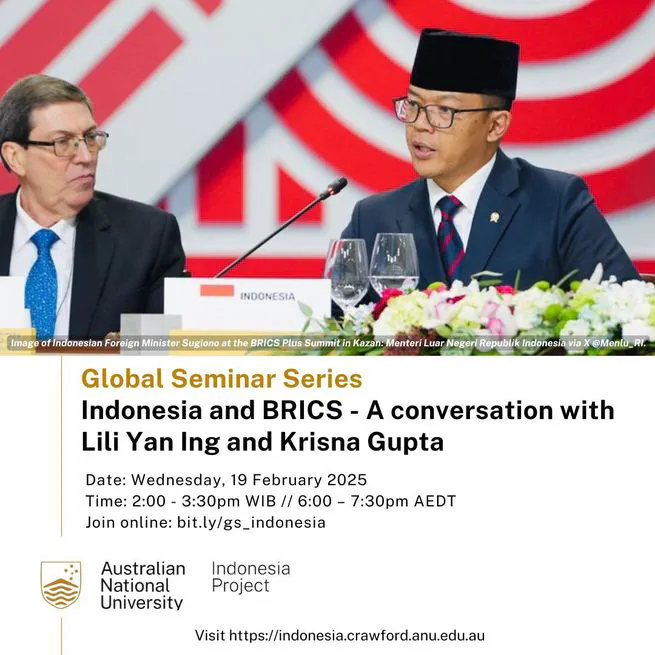
Indonesia and BRICS: A conversation with Lili Yan Ing and Krisna Gupta

In this Global Seminar, we talk with Dr Lili Yan Ing and Dr Krisna Gupta on the economics of Indonesia joining BRICS, a bloc formed by Brazil, Russia, India, and China in 2009 with the addition of South Africa in 2010. What are the benefits to Indonesia?

Feb 19, 2025