Kajian Perekonomian Asia Tenggara
ASEAN Trade and Economic Integration
2026-04-14
Today’s agenda
Part 1: Theory of economic integration — stages, trade creation/diversion, Rules of Origin
Part 2: ASEAN integration in practice — AFTA, AEC, RCEP, GVCs, logistics
Part 3: Geopolitics and current challenges — US-China trade war, Trump tariffs, ASEAN positioning
Wrap-up: Key takeaways and discussion
Why do countries integrate?
Unilateral tariffs are individually rational but collectively harmful — a prisoner’s dilemma
Trade agreements lock in cooperative outcomes and avoid trade wars
Deeper integration reduces transaction costs beyond tariffs: standards, regulation, mobility
Political dimension: peace and stability through economic interdependence (Baldwin and Wyplosz 2020)
Stages of economic integration
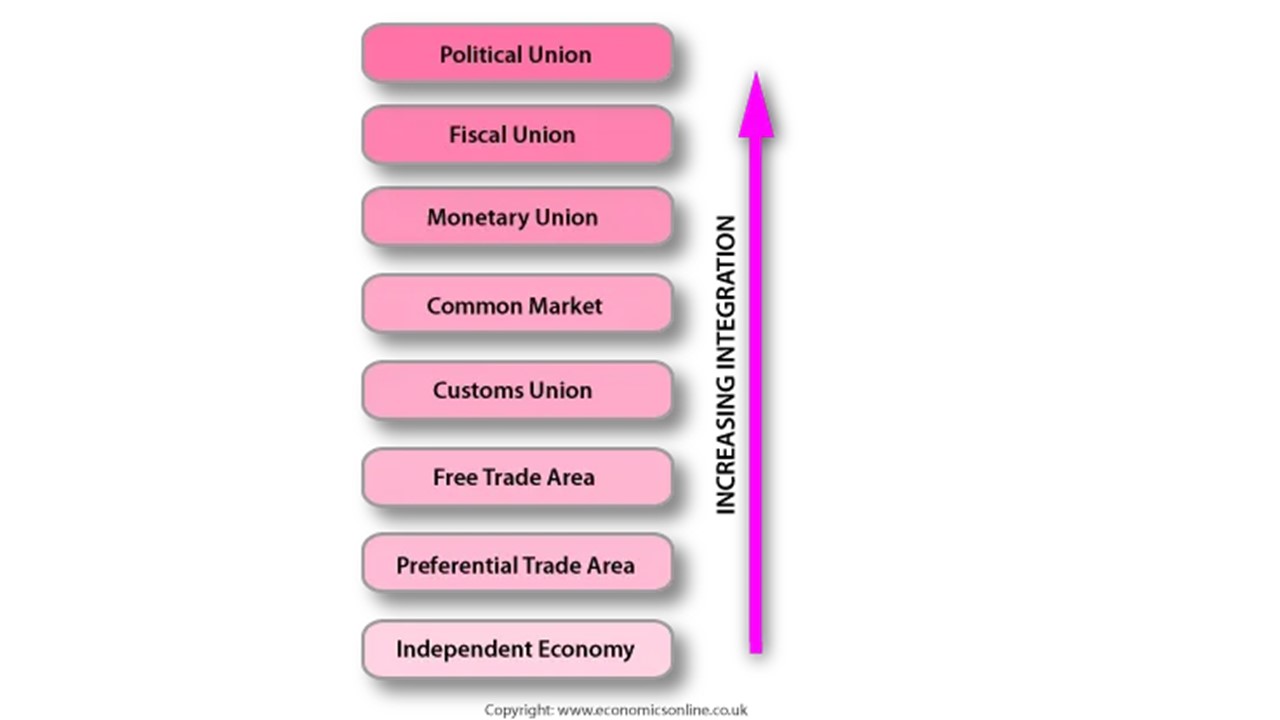
The integration ladder
Preferential Trade Area (PTA): partial tariff reductions among members (e.g., ASEAN PTA 1977)
Free Trade Area (FTA): zero/near-zero tariffs among members, each keeps own external tariff (e.g., AFTA)
Customs Union (CU): FTA + common external tariff (e.g., EU began here in 1968)
Common Market: CU + free movement of labor and capital
Economic/Political Union: common policies, single currency, shared institutions (EU today)
Trade creation vs trade diversion
Trade creation: members switch from costly domestic production to cheaper partner imports — welfare gain
Trade diversion: members switch from efficient non-member to less efficient member — welfare loss
Net effect depends on: member efficiency, initial tariff levels, and complementarity of economies
Key question for ASEAN: are member economies complements or substitutes? (Verico 2022; Widyasanti 2010)
Rules of Origin (ROO)
In an FTA (no common external tariff), ROO prevent “tariff shopping” via the lowest-tariff member
Types: value-added threshold, change in tariff classification, specific process rules
Complex ROO increase compliance costs — act as a hidden trade barrier
ASEAN’s ROO historically fragmented across multiple ASEAN+1 agreements
This fragmentation is called the “noodle bowl” of overlapping FTAs (Widyasanti 2010)
The EU benchmark
EU achieved >60% intra-regional trade share
Customs union since 1968, single market since 1993, single currency (euro) since 1999
Supranational institutions enforce compliance (European Commission, ECJ)
“The ASEAN way” (cara ASEAN) is deliberately different: consensus, non-interference, sovereignty retained (Baldwin and Wyplosz 2020; Ishikawa 2021)
Discussion
Can ASEAN ever achieve EU-level integration? What are the main obstacles?
Think about: political systems, income gaps across members, cultural diversity, sovereignty preferences
Key insight: ASEAN chose flexibility over depth — is that a feature or a bug?
ASEAN Integration in Practice
ASEAN’s integration journey
1967: ASEAN founded — political and security cooperation
1977: ASEAN PTA — first trade preferences among members
1992: AFTA signed — target 0-5% tariffs by 2010 (ASEAN-6) / 2015 (CLMV)
2007: AEC Blueprint — beyond tariffs: services, investment, skilled labor, capital flows
2015: AEC formally launched (but implementation incomplete)
2022: RCEP enters into force — ASEAN + China, Japan, Korea, Australia, New Zealand (Ishikawa 2021; Daniswara and Revindo 2022)
Shallow integration
Intra-ASEAN trade: ~22-23% of total — stagnant for two decades
Compare: intra-EU trade >60%, intra-NAFTA/USMCA ~40%
Extra-ASEAN trade is growing fast, so absolute intra-ASEAN trade grows too — but the share does not
AEC achieved tariff elimination but not deeper integration (Daniswara and Revindo 2022; Revindo 2019)
Why “shallow integration”?
Three key structural reasons:
Substitutes, not complements: ASEAN members export similar goods (palm oil, rubber, electronics assembly) — limited gains from trading with each other
NTMs and complex ROO: non-tariff measures proliferating even as tariffs approach zero; fragmented ASEAN+1 ROO regimes (the “noodle bowl”)
Heavy reliance on CJK: China, Japan, and Korea provide technology, capital goods, and scale — ASEAN integrates more with them than with each other (Verico 2022; Widyasanti 2010)
Logistics: the hidden barrier
Logistics costs in ASEAN remain high and uneven across members
Port infrastructure gaps, especially in CLMV countries (Cambodia, Laos, Myanmar, Vietnam)
Customs procedures and documentation remain complex despite the ASEAN Single Window initiative
Logistics performance strongly predicts bilateral trade flows within ASEAN
Indonesia’s archipelago geography adds unique cost challenges (Ardine and Revindo 2023)
GVC participation and the unbundling framework
Kimura’s 3 unbundlings: (1) production from consumption, (2) tasks from firms, (3) people from tasks via digital technology
ASEAN’s strength: the 2nd unbundling — fragmented manufacturing across borders (electronics, automotive)
But ASEAN is mostly in low-value assembly segments; moving up requires services and technology capabilities
The 3rd unbundling (digital services trade) is the new frontier for ASEAN (Kimura 2018; Revindo 2024)
Supply chain resilience
COVID-19 and US-China tensions exposed concentration risk in global supply chains
Import source diversification improves resilience to supply shocks
ASEAN countries with more diversified import sources recovered faster from disruptions
Policy implication: regional integration (especially RCEP) can help diversify away from single-source dependency (Ar-rafif and Revindo 2025)
RCEP: a game changer?
RCEP unifies ASEAN+1 FTAs into one framework (ASEAN + China, Japan, Korea, Australia, New Zealand)
Key innovation: cumulative Rules of Origin — all 15 members count as “one source region”
Also covers: investment, services trade, e-commerce, intellectual property
Tariff impact modest (most tariffs already low) — but ROO simplification and NTM harmonization are significant
India opted out — implications for supply chain diversification strategy (Daniswara and Revindo 2022; Revindo 2019)
Quick quiz
Why is intra-ASEAN trade share stagnant at ~22% despite tariffs approaching zero?
Hint: think beyond tariffs — what are NTMs? Why does the substitutes-not-complements problem matter?
Follow-up: how might RCEP’s cumulative ROO change the picture?
Geopolitics and Current Challenges
The US-China tariff war
Trade war escalated from 2018: tariffs imposed on ~$550 billion of bilateral trade
Direct effect: trade diversion benefits some ASEAN members (Vietnam, Malaysia)
Indirect effect: uncertainty reduces investment; supply chain restructuring is costly and slow
Net effect on ASEAN: mixed — short-term trade gains but long-term strategic risk (Riefky, Sabrina, and Revindo 2025)
Trade redirection: who benefits?
Vietnam: largest beneficiary — FDI surge, export growth to US markets
Malaysia, Thailand: electronics and auto parts reshoring from China
Indonesia: some gains in textiles and metals, but held back by logistics costs and regulatory barriers
Risk: “transshipment” scrutiny — the US is investigating Chinese goods rerouted through ASEAN members (Riefky, Sabrina, and Revindo 2025)
“Bebas aktif” (independent and active)
Indonesia’s foreign policy doctrine: independent and active — bebas aktif
ASEAN consensus: stay neutral, engage both powers, avoid bloc alignment
“Playing both sides” (main dua kaki) to maximize economic benefit
ISEAS 2024 survey: 50.5% of ASEAN respondents would choose China over the US if forced to pick — trend shifting toward China
But forced alignment remains unlikely; ASEAN’s value is precisely its neutrality
Competing frameworks
RCEP (2022): comprehensive, binding, includes China — trade + investment + services
IPEF (2021): US-led, no market access commitments, pillar-based (supply chains, clean economy, tax, anti-corruption) — status uncertain under Trump 2.0
Bilateral FTAs: Indonesia-UAE CEPA (2024), Indonesia-EU CEPA (ongoing negotiations)
Key tension: RCEP deepens integration with China; IPEF offers no tariff reductions; bilateral deals are piecemeal (Revindo 2019; Ishikawa 2021)
Free Trade Zones / KEK (Kawasan Ekonomi Khusus)
FTZs offer tariff and regulatory exemptions in designated areas to attract FDI
Case study: Oecusse-Ambeno (Timor-Leste) — FTZ impact on local economic growth
ASEAN examples: Batam (Indonesia), Iskandar (Malaysia), various SEZs across the region
Can bypass national-level integration barriers — but risk a “race to the bottom” on regulation (Shaohong and Revindo 2024)
2026 context
Trump’s “Liberation Day” tariffs (April 2025): broad reciprocal tariffs on ASEAN members
Indonesia hit with 32% tariff (among the highest); Vietnam 46%, Thailand 36%
ASEAN response: negotiation, not retaliation — bebas aktif (independent and active) in action
Trade redirection accelerating: Chinese firms setting up operations in ASEAN to circumvent US tariffs
Indonesia’s opportunity: attract manufacturing — but requires regulatory reform, logistics investment, and human capital upgrading
Discussion
Is ASEAN’s neutrality sustainable in an increasingly polarized world?
Should Indonesia prioritize RCEP deepening, bilateral FTAs, or domestic reform?
What would “forced to choose” look like in practice — and what would it cost?
Key takeaways
ASEAN chose shallow, flexible integration — “the ASEAN way” — a deliberate trade-off against EU-style depth
Tariffs are mostly gone; the real barriers are NTMs, logistics, ROO complexity, and structural similarity among members
RCEP is the most significant recent development — cumulative ROO could be transformative
Geopolitical competition (US-China) creates both risks and opportunities for ASEAN
Indonesia must invest in logistics, regulatory reform, and GVC upgrading to capture these gains
Questions for next week
How can ASEAN move from “shallow” to “deep” integration without becoming the EU?
What is the optimal trade strategy for Indonesia in the current geopolitical environment?
Can digital trade (the 3rd unbundling) help ASEAN leapfrog traditional integration barriers?
Reading list
- Baldwin and Wyplosz (2020) — Ch. 1-3 (integration theory)
- Verico (2022) — ASEAN integration principles
- Kimura (2018) — unbundlings and development strategies
- Ardine and Revindo (2023) — logistics and intra-ASEAN trade
- Riefky, Sabrina, and Revindo (2025) — US-China tariff war impact
- Ar-rafif and Revindo (2025) — import diversification and supply chain resilience
