The Brazilian Chicken Import Dispute: Where There's Corn, There's Chicken
Another week, another trade related post! Recently, netizens were startled (again) by news that Indonesia would import chicken from Brazil. This was the result of Brazil filing a dispute against Indonesia at the WTO for blocking Brazilian chicken imports, and Indonesia lost. This means Indonesia must relax its chicken import restrictions.
This dispute is quite interesting. Although Brazil was the first to file against Indonesia, other countries supported Brazil, including the United States, the European Union, Japan, China, Australia, Vietnam, and others. Besides chicken, Indonesia is also being challenged on beef import restrictions (also by Brazil). Additionally, the United States and New Zealand are suing Indonesia over horticultural imports (yes, the garlic import bribery scandal was because of this regulation) and animal products.
Chicken imports (and beef) are one of many restricted imports in Indonesia. The restriction is governed by Ministry of Trade Regulation No. 20/2018 on animal and animal product export-import provisions. Under this regulation, anyone wishing to export or import animals and animal products must obtain a permit from the Ministry of Trade.
For the Sake of National Chicken!
Why does Indonesia restrict chicken imports? The easiest answer is, of course, to protect the livestock industry (for the theory, see the garlic import post). Indonesia’s livestock industry appears unable to compete with foreign products. According to an article from beritagar, the cost of production for local chicken is around IDR 18,000 to 19,000 per kg. This means if local chicken sells at IDR 22,000 per kg, farmers profit a maximum of IDR 3,000 per kg. Meanwhile, Brazilian chicken can sell for as low as IDR 10,000 per kg. That’s a massive gap!
On the other hand, the government has a duty to keep inflation stable. The government decides what market price is appropriate. If it’s too expensive, the government instructs BULOG to import. If the government considers it still cheap? Imports are halted.
Thanks to these chicken import restrictions, poultry farmers are protected from prices that are too low and can enjoy prices “stabilized” by the government. Besides poultry farmers, those who benefit are probably the officials tasked with developing the livestock industry. Livestock grows, that means good performance. If imports are free, livestock farms shut down, meaning poor performance.
Of course, direct consumers are the ones who lose. You, me, our mothers at home who love cooking chicken. But it’s fine. Netizens are resilient. For the sake of domestic products. (What about industries that use chicken as an input? According to the Ministry of Trade regulation above, companies can import chicken for input using APIP. But the quotas appear to still be set by the Ministry of Trade, so they can’t import freely either.)
Chicken: Eating and Being Eaten
The chicken story is somewhat similar to garlic. Foreign production is cheaper, it’s restricted, and importers reap profits. But chicken is a bit more interesting for at least two reasons.
First, unlike garlic where imports can reach 95% of total domestic demand, chicken imports are relatively small – about 76,000 tons in 2018. Domestic broiler production has been trending upward, reaching 2.1 million tons in 2018. Unlike garlic where the number of farmers is small, the poultry industry is quite large. In other words, a lot of farmers would lose if Brazilian chicken suddenly entered the market. Many Indonesian citizens depend on chicken for their livelihoods.
The second reason, still about eating, but from the chicken’s perspective. There are many reasons why our farmers are less productive than Brazilian farmers, but the number one issue appears to be feed. The main livestock feed is corn, and corn prices in Indonesia are apparently quite expensive. Expensive feed means farmers can’t push down production costs. This is something I didn’t discuss in my garlic post. I only said that our garlic farmers are less productive, but I don’t fully understand how to outcompete Chinese farmers.
But for chicken, reducing feed costs means reducing production costs. Reducing corn prices could be one key to beating Brazilian farmers. So the question now shifts: How do we reduce corn prices? It doesn’t seem easy. Because… Yes, you guessed it! We also import a lot of corn!
According to the article on corn above, poultry farmers need corn prices at around IDR 4,000 to be competitive at chicken prices around IDR 22,000. FAO data shows that local corn prices are usually stable around IDR 4,000. But from UNCOMTRADE, imported corn prices can be as low as IDR 3,000.
Why are international prices different from local prices? The answer, of course, is that our corn imports are restricted! Corn imports are governed by Ministry of Trade Regulation No. 21/2018 on corn import provisions. Under this regulation, corn imports for feed can only be done by BULOG, while corn imports for food and industry can be done by BULOG and factories. Of course, the timing and quantities are determined by the government.
Same as chicken. Corn farmers want high prices, poultry farmers want low prices. The government, rather than having them fight, chooses to mediate by controlling prices themselves. So where do we import corn from? The figure below shows the answer.
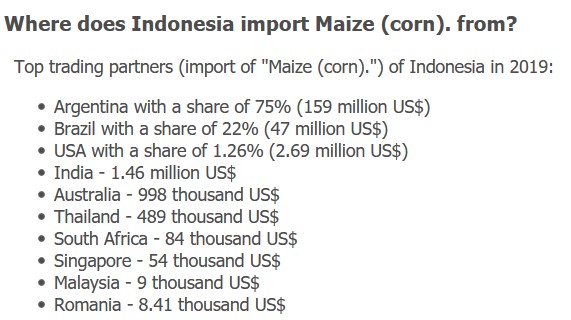
Indonesia’s corn imports in 2019 (source: tradeconomy.com)
Yes! Most of our corn imports come from Argentina and Brazil! No wonder Brazilian chicken is cheap – they’re among the world’s cheapest corn producers, cheap enough to export. So our farmers are competing against a country with the same feed source, only ours is more expensive because corn imports are restricted (and of course there are cost, freight, and insurance margins on top).
Policy Piling Upon Policy
The corn import regulation was created to protect corn farmers. But as a result, corn prices are high, and poultry farmers who use corn as input become uncompetitive, necessitating yet another protective policy. Both regulations are also being challenged by Brazil (for chicken) and New Zealand (for horticulture). The Ministry of Trade and those overseeing horticulture and poultry must be quite stressed right now.
Unlike garlic where there are genuinely few domestic farmers, both corn and chicken are industries with a significant number of domestic players. The government, which has long relied on restrictive policies, is now forced to find different ways to advance agriculture (especially corn) and livestock (especially chicken).
For consumers, Brazilian chicken could push down chicken meat prices further. Indonesia’s meat consumption is still very low. If I’m not mistaken, chicken consumption in Indonesia is only about 5 kg per capita per year. Beef is probably even lower. Brazilian chicken could help.
That’s the end of my post about chicken and corn. If readers have any input, I’ll update accordingly. I’m not an expert on corn or chicken – just someone with time on their hands. Thanks for reading!